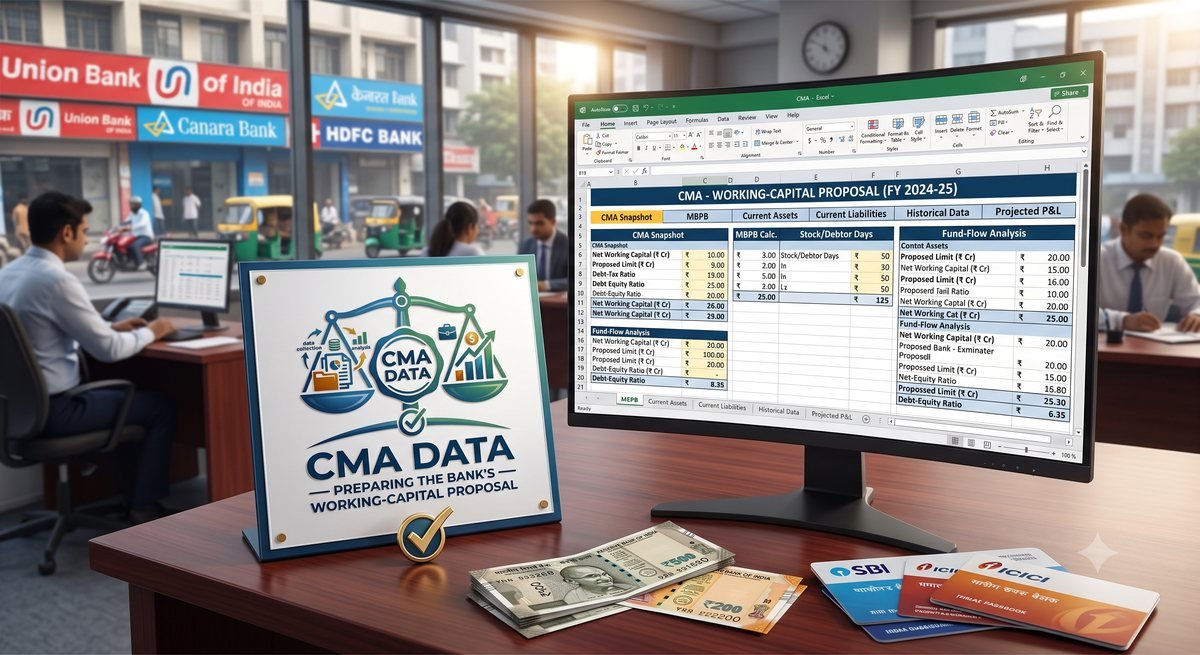
CMA data, preparing the bank's working-capital proposal
The pack every bank appraises your working-capital limit on. The seven statements, how MPBF sizes your facility, the ratios that decide it, and the assumptions they'll challenge.
ReadGSTR-2B vs purchase register, reconciling input tax credit
Your ITC is only as safe as its match to GSTR-2B. The four match buckets, why the credit now needs the invoice in 2B, and how to fix the mismatches before the November deadline.
Read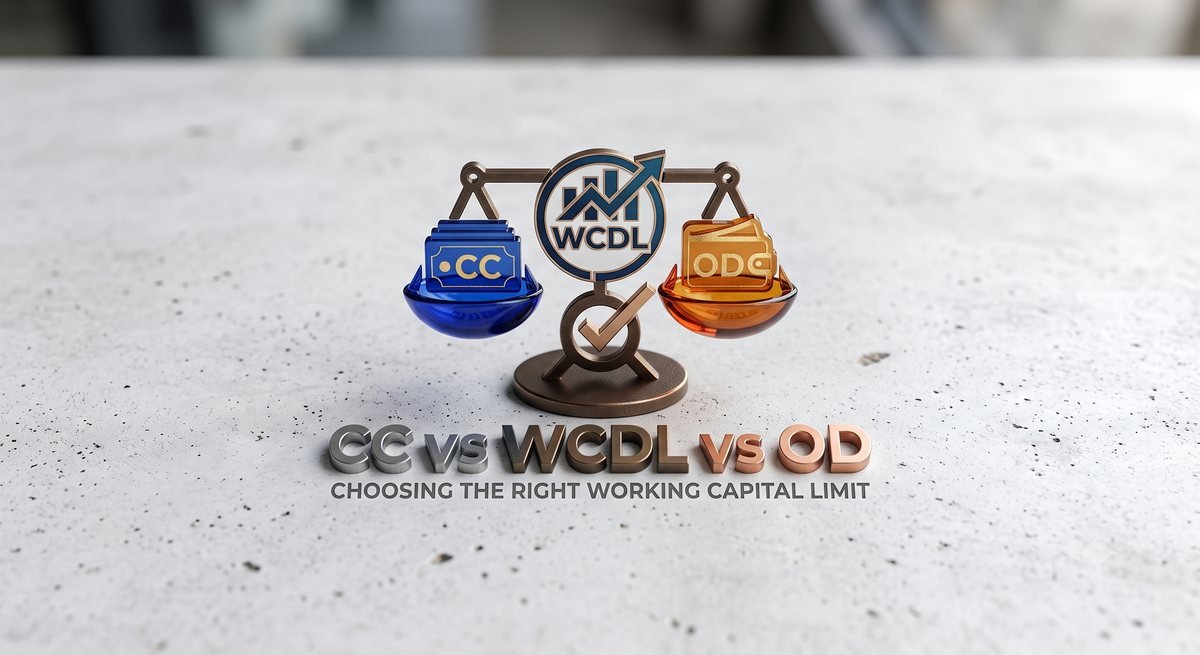
CC vs WCDL vs OD, which working capital facility to draw?
Cash Credit revolves against a drawing power formula; WCDL locks in a fixed-rate tranche from day one; OD sits on collateral with no DP calculations. The decision logic, the drawing power trap, and what banks won't tell you about the mix.
ReadPCFC: packing credit in foreign currency, and how to cost it
Pre vs post-shipment, the natural hedge that comes free with dollar financing, a worked PCFC-vs-rupee cost comparison, and the crystallisation trap.
ReadLetter of credit (LC): how it works, the types, and the full process
The parties, the step-by-step process, sight vs usance, confirmed vs unconfirmed, freely negotiable vs restricted, the bill of exchange, MT700 fields and costs. With India import and export examples.
ReadBank guarantee (BG): the types, how it works, and BG vs LC
Performance, financial, advance payment and bid bond guarantees, how a BG works, what it costs, invocation, and the difference between a bank guarantee and a letter of credit.
ReadIncoterms 2020 explained: EXW, FOB, CIF, DAP, DDP and all 11 rules
What each three-letter rule means, who pays freight, insurance and duty, where risk passes, FOB vs CIF, and which term to use for containers. With India import and export examples.
ReadForward cover is the wrong default in India, the case for natural hedging
Banks push forward cover as prudent, often as "mandatory". In a structurally depreciating rupee, it mostly pays the bank. The case for natural hedging, from a business that ran open and won.
ReadPower BI for finance teams, from raw ERP to board-ready MIS
The data model, the DAX finance actually needs, and self-refreshing dashboards, drawn from a real ₹700 Cr Power BI MIS build.
ReadSAP Business One vs Dynamics 365 Business Central
A practitioner's comparison from working with both: fit, the Microsoft ecosystem, localisation, cost, and how to actually choose.
ReadFinance interview questions, and how to actually answer them
Common accounting, FP&A, treasury and behavioural questions with strong, specific model answers, and a framework for any of them.
ReadGST on export of services: zero-rated, LUT and refunds
The five conditions to qualify, LUT vs paying IGST, the refund routes, and the mistakes that block your input tax credit.
ReadThe working capital cycle, explained
Debtor, inventory and creditor days, the cash conversion cycle, and a worked example showing exactly how much cash the cycle ties up.
ReadWhat is DSCR? Debt Service Coverage Ratio, explained
The formula, a worked example, the 1.25-1.5x lenders look for, and how to actually improve it on a term-loan structure.
ReadEDPMS / IDPMS reconciliation, automated in Business Central
Auto-fetch shipping bills from email with Python, push them into Business Central, and match every export to its realisation and eBRC, before the caution list bites.
ReadHow to calculate CAGR (with examples)
The formula, worked examples, the Excel one-liner, and why CAGR can quietly mislead when there's volatility or interim cash flows.
ReadIRR vs XIRR, what's the difference?
Why XIRR handles real, irregular cash-flow dates and IRR doesn't, with a worked example and the sign-convention gotchas.
ReadFinding the real IBR, and negotiating the FX spread to 1 paise
Banks hide the true interbank rate under names like "cash-pot IBR". How I benchmarked it to xe.com and negotiated the FX spread to 1 paise (Pharma API) and 2 paise (Petrochemical).
ReadDecoding the FX quote: value dates, TT vs card, and forward points
The rate your bank quotes is a stack, not a number: mid, value date, forward points, spread. Which layer is arithmetic, which is the market, and which single piece you can actually negotiate.
ReadDesigning an IFC framework for a mid-market company
A risk-control matrix that satisfies the Companies Act without a 200-control monster, built from real process risks and encoded into the ERP so evidence is free.
ReadThe SEBI LODR compliance calendar, a listed company's quarterly rhythm
What a listed company files every quarter: results (45/60 days), shareholding & governance (21 days), and the Reg 30 material-event clock measured in hours, plus where companies actually get fined.
ReadRegulation 30, what actually triggers a material-event disclosure
Deemed vs assessed material events, the quantitative threshold (lower of 2% turnover / 2% net worth / 5% of avg PAT), the 30-min clock, and the materiality policy that lets a call get made at 6pm without the board.
ReadBuyer's credit, fully hedged, getting the all-in cost to 6.11%
Why buyer's credit beats domestic borrowing when the dollar is high: the 120-day structure, a same-day forward, and how the all-in cost lands at 6.11%.
ReadHow to build a finance function from greenfield in 7 months
The playbook from a real asset buyout: SOPs, ERP, banking, audit, moving an acquired entity from zero infrastructure to mature operations.
ReadIndAS consolidation across 4 foreign subsidiaries, what actually breaks
Eliminations, FX translation, intercompany loans, NCI. The specific stages where consolidation goes wrong, and how to design the close cycle to T+0.
ReadMore writing on the way.
Next pieces in the pipeline: Structuring ₹440 Cr across 8 banks: ECLGS, WCDL & buyer's credit, Month-end close at T+0, the working checklist, and e-invoicing & e-way bill in Business Central. Get in touch if there's something specific you want covered.